
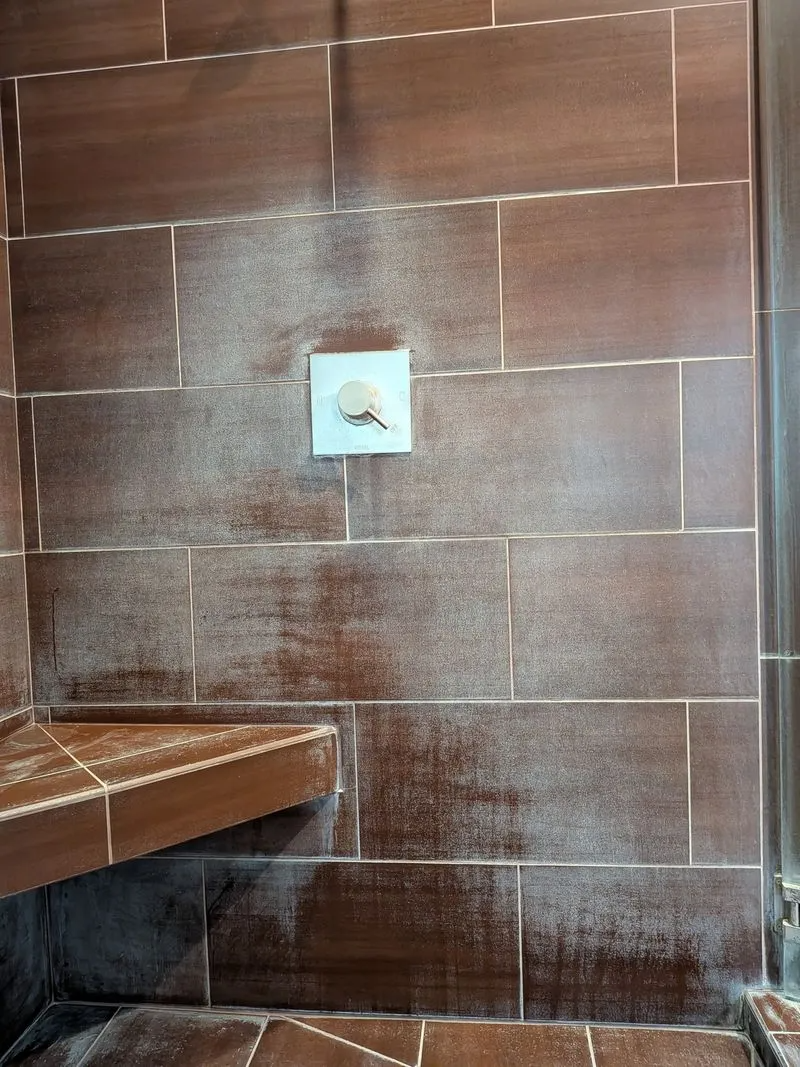
Why hard water spots and soap scum keep returning to shower glass, how PNW water differs by city, and what actually removes them.
You clean your shower glass.
It looks clear.
Then a few days later, the haze is back.
White spots appear.
The glass looks cloudy.
Soap residue builds along the edges.
And the tile and grout start looking dull again.
If you live in the Pacific Northwest, this can be especially frustrating.
But the problem isn't always simply "hard water."
Cloudy shower glass and stubborn shower buildup are usually caused by a combination of minerals in the water, soap and personal-care products, body oils and water repeatedly drying on the surface. Water hardness varies considerably across the Portland-Vancouver region, which means one home may experience much more mineral buildup than another.
Understanding what's actually on the glass is the first step toward keeping it cleaner.
Is Water Hard in the Pacific Northwest?
There isn't one answer for the entire Pacific Northwest.
Water hardness varies depending on where you live and where your water comes from.
That is especially true in the Portland-Vancouver metro area.
Portland's primary Bull Run water supply is naturally soft.
Other water sources throughout Southwest Washington and surrounding communities can contain higher concentrations of dissolved minerals.
Even within the same metro area, two homeowners may experience very different levels of mineral spotting.
That is why one person's shower glass may remain relatively clear while another homeowner fights white deposits constantly.
Your specific water source matters.
What Is Hard Water?
Hard water contains higher concentrations of dissolved minerals, particularly calcium and magnesium.
Those minerals are carried in the water while it is flowing.
The problem becomes visible when the water evaporates.
The water disappears.
The minerals do not.
They remain behind on the surface.
Over time, repeated wetting and drying can create visible deposits on:
Shower glass
Tile
Faucets
Fixtures
Showerheads
Grout
Countertops
Other bathroom surfaces
Those deposits often appear as white spots, cloudy residue or a chalky film.
Why Does Shower Glass Look Cloudy?
Cloudy shower glass is often more complicated than simple water spots.
Several types of residue can accumulate at the same time.
Mineral Deposits
When water evaporates, dissolved minerals can remain on the glass.
Repeated deposits gradually create visible spotting or haze.
Soap Scum
Soap can react with minerals in water and combine with oils and other residue.
The result can be a film that sticks to glass and tile.
Body Oils
Natural skin oils can combine with soap and personal-care products.
Shampoo and Conditioner
Many shower products contain ingredients designed to remain on hair or skin.
Small amounts can also remain on nearby glass and tile.
Cleaning-Product Residue
Sometimes the product being used to clean the shower becomes part of the buildup.
If cleaning products aren't thoroughly rinsed or removed, residue can remain on the glass.
Over time, these layers can create the cloudy appearance homeowners often describe as "hard water stains."
What Is Soap Scum?
Soap scum is the film that develops when soap, body oils, minerals and other contaminants accumulate on bathroom surfaces.
It can appear:
White
Gray
Cloudy
Waxy
Chalky
Slightly greasy
Shower glass makes it especially noticeable because even a thin layer changes the clarity of the surface.
Soap scum can also build up on:
Ceramic tile
Porcelain tile
Natural stone
Grout
Fixtures
Shower doors
Tub surrounds
The longer it remains, the more difficult it can become to remove.
Why Does Soap Scum Come Back So Quickly?
Because the conditions creating it happen every time you shower.
Water hits the glass.
Soap is used.
Shampoo and conditioner are rinsed.
Body oils enter the water.
Then the shower dries.
A small amount of residue may remain.
Repeat that process once or twice a day.
Then multiply it by weeks, months or years.
The buildup makes more sense.
Even after a deep cleaning, the cycle immediately starts again unless routine maintenance reduces what remains on the surface.
Why Do Hard Water Spots Keep Returning?
Cleaning removes existing deposits.
It doesn't change the water coming from your showerhead.
If your water contains enough dissolved minerals to leave visible deposits, new spots begin forming as soon as water dries on the glass again.
That's why a homeowner can spend hours removing mineral buildup only to see new spots appear within days.
Professional restoration can remove accumulated buildup.
Ongoing maintenance helps prevent the next layer from becoming established.
Why Can Shower Glass Become Harder to Clean Over Time?
Fresh water spots are generally easier to address than years of accumulated deposits.
Over time, minerals, soap and oils can build layer upon layer.
The surface may progress from:
Light spotting.
To visible haze.
To stubborn deposits.
To glass that never seems completely clear.
The longer contamination remains, the more difficult restoration can become.
That is why periodic maintenance matters.
Can Hard Water Permanently Damage Shower Glass?
Long-term mineral buildup can sometimes affect the appearance of glass beyond ordinary surface residue.
Mineral deposits that remain for extended periods may become increasingly difficult to remove, and some glass can develop etching or other surface changes.
At that point, cleaning alone may not completely restore the original clarity.
This is another reason homeowners should address persistent mineral buildup instead of allowing it to accumulate for years.
Professional evaluation can help determine whether you're looking at removable residue or actual surface damage.
Why Is This Such a Problem in Pacific Northwest Bathrooms?
Water hardness isn't the only factor.
Moisture management also matters.
The Pacific Northwest spends a significant portion of the year in cool, wet conditions.
During rainy months, homeowners are less likely to open windows and indoor spaces may dry more slowly without adequate ventilation.
Bathrooms already generate significant moisture.
A long, hot shower can leave:
Glass wet
Tile wet
Grout damp
Mirrors covered in condensation
Humidity elevated throughout the room
If surfaces stay wet longer, there is more time for residue to remain as water evaporates.
That's why ventilation is particularly important in Pacific Northwest bathrooms.
Portland vs. Vancouver: Why Water Buildup Can Be Different
This is an important local distinction.
A homeowner in Portland may have a very different water experience than someone just across the Columbia River in Vancouver.
Portland's primary Bull Run supply is naturally soft.
That means many Portland homeowners may experience less classic hard-water mineral buildup than homeowners supplied by harder groundwater sources.
Vancouver and other Southwest Washington communities rely heavily on groundwater, which can contain more dissolved minerals.
That can lead to more noticeable:
Water spots
Mineral residue
Faucet deposits
Shower glass buildup
Scale around fixtures
Even within a city, water sources and conditions can vary.
So when someone says, "Pacific Northwest water is hard," that is too broad.
The more accurate answer is:
Water hardness varies throughout the region, and your specific water source influences how much mineral buildup you see.
Does Soft Water Mean Portland Showers Stay Clean?
Unfortunately, no.
Even relatively soft water doesn't eliminate:
Soap residue
Body oils
Shampoo
Conditioner
Cleaning-product residue
Moisture
Grout contamination
Everyday bathroom buildup
That means Portland homeowners can still develop cloudy glass and dirty-looking showers even without significant hard-water minerals.
Hard water is only one part of the equation.
Why Doesn't Household Glass Cleaner Fix Shower Glass?
Household glass cleaner is usually designed to remove fingerprints, light residue and ordinary surface contamination.
A shower is a different environment.
You may be dealing with layers of:
Minerals
Soap residue
Oils
Shampoo
Conditioner
Cleaning products
Years of accumulated buildup
Simply spraying the glass and wiping it may remove the top layer without addressing what is underneath.
This is why many homeowners repeatedly clean shower glass but never achieve the clarity they expect.
What About Vinegar for Hard Water Stains?
Vinegar is commonly recommended for mineral deposits because it is acidic.
That can make it useful on certain compatible surfaces.
But homeowners should be careful.
A shower isn't always made entirely of glass.
The same cleaner may contact:
Grout
Natural stone
Metal fixtures
Sealers
Caulk
Tile
Acid-sensitive natural stones such as marble, limestone and travertine can be damaged by vinegar and other acidic products.
Before applying a DIY hard-water solution throughout the shower, know what materials surround the glass.
Can You Use Abrasives on Shower Glass?
Use caution.
Aggressive pads, powders or scraping methods may create scratches or damage certain coatings and finishes.
Some modern shower glass also has factory-applied protective coatings that require specific maintenance.
Always follow the manufacturer's cleaning guidance when you know the glass has a specialty treatment.
When the buildup is significant, professional evaluation can reduce the temptation to keep escalating to more abrasive methods.
How Everstone Professionally Restores Shower Surfaces
At Everstone Surface Solutions, we look at the shower as one complete hard-surface environment.
Glass.
Tile.
Grout.
Stone.
Fixtures.
Each material may require a different approach.
Our philosophy is:
Clean. Restore. Protect.
Step 1: Evaluate the Shower
We start by determining what surfaces are present and what's causing the visible buildup.
That may include:
Mineral deposits
Soap residue
Body oils
Product buildup
Dirty grout
Natural stone
Existing sealers
Surface damage
Etching
Other conditions affecting restoration
This helps us determine which problems are cleaning issues and which may involve permanent surface changes.
Step 2: Select the Appropriate Professional Chemistry
Everstone uses proprietary commercial-grade cleaning products developed for professional hard-surface restoration.
Our cleaners and sealers were developed with professional chemistry expertise.
This matters because mineral deposits, soap scum, oils and ordinary dirt aren't the same thing.
Different contaminants may require different treatment.
We don't rely on one universal cleaner for every surface.
Step 3: Use High-Temperature Vapor When Appropriate
Everstone uses professional vapor equipment that produces temperatures reaching up to 330°F at the equipment.
High-temperature vapor gives our technicians another tool for loosening accumulated residue and cleaning grout lines, textured surfaces and other difficult areas.
It is used as part of our professional cleaning and sanitizing process when appropriate for the material being treated.
Step 4: Detail the Entire Shower
A restored shower isn't simply clean glass.
We pay attention to:
Glass
Tile
Grout lines
Corners
Edges
Fixtures
Textured surfaces
Areas where buildup is concentrated
That complete approach can make a significant difference in how the entire shower looks.
Step 5: Protect Appropriate Porous Surfaces
After appropriate grout, tile or natural stone has been professionally cleaned and prepared, Everstone can apply our proprietary commercial-grade sealer where appropriate.
Everstone backs that sealer with a 5-year limited warranty against sealer failure — peeling, flaking or excessively rapid wear. Full terms are on our warranty page.
The sealer helps reduce future penetration of moisture, stains and contaminants into porous surfaces.
It does not make the shower maintenance-free.
It helps make appropriate surfaces easier to maintain.
Can Shower Glass Be Protected Too?
Some glass surfaces can receive protective treatments designed to make water and residue less likely to adhere.
The appropriate option depends on the type and condition of the glass and whether an existing manufacturer-applied coating is present.
The first priority is always getting the surface properly cleaned and understanding its condition.
Protection works best when applied to a properly prepared surface.
How Can You Keep Shower Glass Cleaner?
The best time to fight buildup is before it becomes buildup.
A few simple habits make a significant difference.
Squeegee After Every Shower
This may be the simplest and most effective maintenance habit.
Removing water before it evaporates reduces the amount of mineral and soap residue left behind.
It takes less than a minute.
Keep a Microfiber Cloth Nearby
Drying glass and fixtures can further reduce spotting.
Run the Bathroom Exhaust Fan
Use the exhaust fan during showering and continue running it afterward.
Reducing humidity helps the entire shower dry faster.
Keep the Shower Open When Practical
Allowing airflow through the enclosure can help surfaces dry.
Clean Light Buildup Regularly
Do not wait until the glass becomes completely cloudy.
Frequent light maintenance is generally easier than removing months of accumulated residue.
Use the Correct Product
Know what materials are in your shower before using acidic, abrasive or aggressive cleaners.
Address Mineral Buildup Early
If your home has harder water, don't allow visible deposits to accumulate for years.
Should You Get a Water Softener?
If your home has genuinely hard water and mineral buildup is occurring throughout the house, a water-treatment professional can evaluate whether a softening system makes sense.
A water softener addresses minerals at the water source.
Professional surface restoration addresses deposits that are already on the surface.
They solve different problems.
And in areas with naturally soft water, a softener may not be necessary.
Before investing in equipment, find out the actual hardness of your home's water.
How Do You Find Out How Hard Your Water Is?
Start with your water provider.
Municipal utilities typically publish water-quality information.
If you have a private well or want information specific to your individual home, water testing can provide more precise results.
This is especially useful in the Pacific Northwest because water hardness varies substantially between communities and water sources.
Can Old Shower Glass Look Clear Again?
Sometimes the improvement can be dramatic.
But the result depends on what has happened to the glass.
If the cloudy appearance is primarily caused by removable mineral and soap buildup, professional restoration may significantly improve clarity.
If the glass has been permanently etched, scratched or otherwise damaged, cleaning may not return it to its original condition.
That is why Everstone evaluates the surface before promising a particular result.
Professional Shower Restoration in Portland and Vancouver
Everstone Surface Solutions brings 10+ years of Pacific Northwest experience on every crew, servicing residential and commercial hard surfaces across the region.
That local experience matters because water and environmental conditions aren't identical throughout our service area.
Portland homeowners may primarily receive naturally soft Bull Run water.
Vancouver and surrounding Southwest Washington communities may experience higher mineral concentrations from groundwater.
Across both sides of the Columbia, bathrooms still deal with moisture, soap, oils and everyday use.
Everstone's professional restoration process combines:
Surface identification and evaluation
High-temperature vapor reaching up to 330°F when appropriate
Proprietary commercial-grade cleaners and sealers
Products developed with professional chemistry expertise
Detailed shower, tile and grout restoration
10+ years of Pacific Northwest experience on every crew
We don't automatically assume every cloudy shower has the same problem.
We determine what's actually on the surface and select the appropriate treatment.
Your Shower Is Fighting More Than Water
Minerals are part of the problem.
So is soap.
Body oils.
Shampoo.
Moisture.
And thousands of cycles of getting wet and drying again.
That's why shower glass can become cloudy even when you clean regularly.
Everstone Surface Solutions combines professional surface evaluation, high-temperature vapor reaching up to 330°F when appropriate, proprietary commercial-grade cleaners and sealers, products developed with professional chemistry expertise and 10+ years of Pacific Northwest experience on every crew to clean, restore and protect hard surfaces.
And because water conditions vary throughout Portland, Vancouver and the surrounding region, we don't assume every shower needs the same treatment.
We evaluate what's actually happening to your surfaces first.
Clear the buildup. Restore the surface. Make it easier to maintain.
Restore. Protect. Enjoy.
Contact Everstone Surface Solutions to request a free estimate for professional shower, tile, grout and hard-surface restoration in the Portland and Vancouver metro area.*
Frequently Asked Questions
Why does my shower glass keep getting cloudy?
Cloudy shower glass is commonly caused by a combination of mineral deposits, soap residue, body oils, personal-care products and water repeatedly drying on the glass.
Is Portland water hard?
Portland's primary Bull Run water supply is naturally soft. Portland can also use groundwater that is moderately harder. Your specific water source influences the amount of mineral buildup you may experience.
Is Vancouver, Washington water harder than Portland water?
Water conditions differ across the metro area. Vancouver and other Southwest Washington communities rely heavily on groundwater, which can contain higher concentrations of hardness minerals than Portland's primary Bull Run supply.
Why do I still get soap scum if my water is soft?
Soap scum and shower residue aren't caused by minerals alone. Soap, body oils, shampoo, conditioner and other products can build up even in homes with relatively soft water.
What causes white spots on shower glass?
White spots commonly form when water containing dissolved minerals dries and leaves those minerals behind on the glass.
Can professional cleaning remove hard water stains from shower glass?
Professional cleaning can significantly improve many types of mineral and soap buildup. Results depend on how long deposits have been present and whether the glass has experienced permanent etching or other damage.
Why does hard water buildup keep returning?
Cleaning removes existing mineral deposits but does not change the mineral content of the water. New deposits can form each time water dries on the glass.
How can I prevent shower glass from getting cloudy?
Squeegeeing after use, drying the glass, improving bathroom ventilation, cleaning light buildup regularly and using appropriate protective treatments can help reduce future accumulation.
Can vinegar remove hard water stains?
Acidic cleaners may help dissolve some mineral deposits on compatible surfaces, but vinegar is not appropriate for all materials. It can damage acid-sensitive natural stone such as marble, limestone and travertine.
Does Everstone restore showers in Portland and Vancouver?
Yes. Everstone Surface Solutions provides professional shower, tile, grout and hard-surface cleaning, restoration and protection for residential and commercial properties throughout the Portland and Vancouver metro area and surrounding Pacific Northwest communities.