
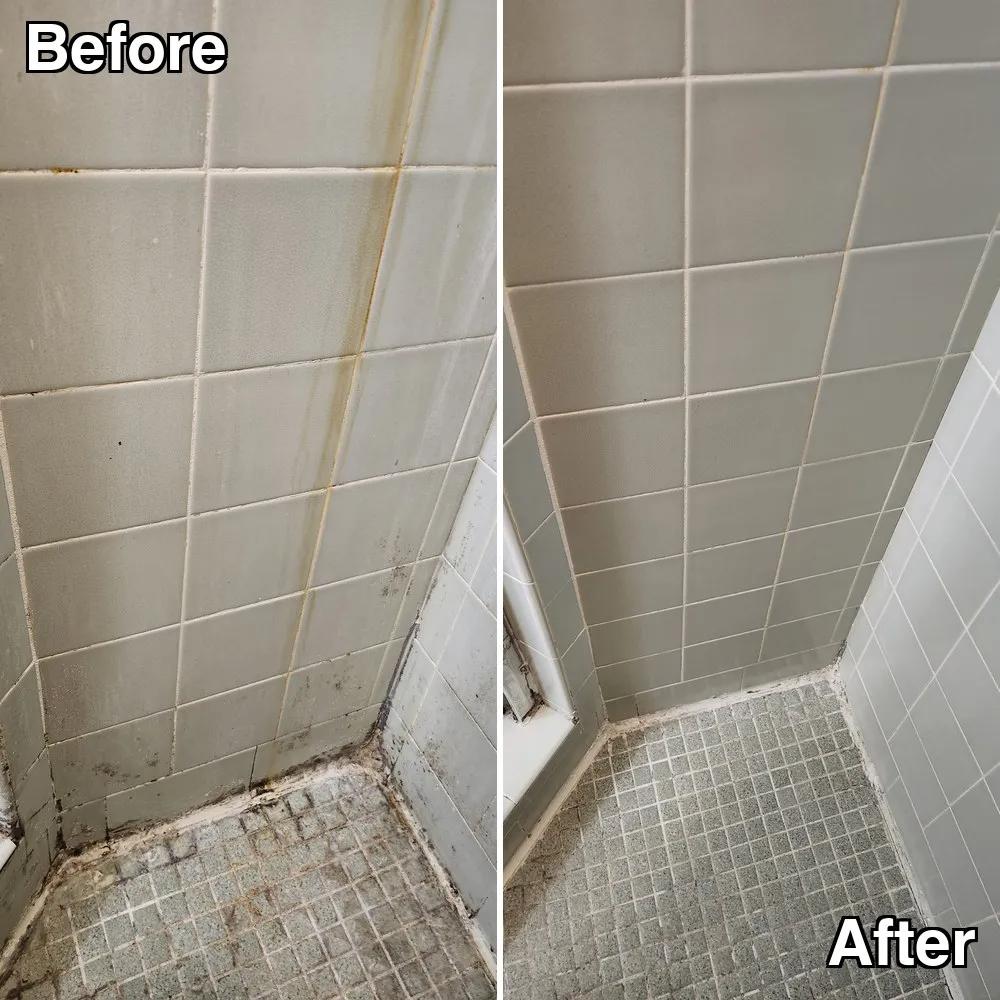
DIY grout cleaners can discolor grout, etch natural stone and leave residue. What to avoid, and when to call a professional.
Search for "how to clean grout" and you'll find no shortage of advice.
Vinegar.
Bleach.
Baking soda.
Hydrogen peroxide.
Dish soap.
A stiff brush.
A steam cleaner.
Some of those methods may help in certain situations.
The problem is that they are often recommended as if every grout line and every tile surface are the same.
They aren't.
The hidden problem with DIY grout cleaners is that the product may interact with more than the grout. It can also affect surrounding tile, natural stone, existing sealers, caulk and other materials. The wrong cleaner, concentration or technique can leave residue, discolor surfaces or potentially cause damage.
And even when a DIY cleaner is safe, it may still only address the dirt you can reach at the surface.
That's why professional grout cleaning starts with identifying the material before selecting the treatment.
Why Are DIY Grout Cleaners So Popular?
Grout is frustrating.
You clean the floor, but the grout still looks dark.
You scrub the shower, but the lines never seem completely clean.
You wipe the backsplash, but grease remains around the grout near the stove.
So it makes sense that homeowners look for stronger solutions.
DIY grout-cleaning recipes are popular because they usually involve inexpensive products already in the house.
The problem is that "stronger" does not always mean "better."
A cleaner that works on one surface can be inappropriate for another.
Why Grout Is Harder to Clean Than Tile
Grout and tile are different materials.
Many tile surfaces are relatively smooth and easy to wipe clean.
Traditional cement-based grout is often porous.
That means dirt, moisture, oils, soap residue and other contaminants can work into pores and surface irregularities instead of remaining entirely on top.
Over time, grout can collect:
Dirt
Soap residue
Body oils
Cooking grease
Food oils
Minerals
Mop residue
Moisture
Everyday contaminants
Once that buildup becomes embedded, routine cleaning may stop producing the results you expect.
That is often when homeowners begin experimenting with stronger DIY formulas.
Is Vinegar Safe for Grout?
Vinegar is one of the most common DIY cleaning recommendations.
But it is acidic.
That matters.
Acidic cleaners can interact differently with different materials, particularly natural stone and some cement-based surfaces.
Marble, limestone and travertine are especially sensitive to acids.
Vinegar can etch certain natural stone surfaces, changing the finish and appearance.
Even if the grout itself seems unaffected, the surrounding material may not be.
The safer rule is simple:
Know what surface you have before using an acidic cleaner.
Can Baking Soda Damage Grout or Tile?
Baking soda is often recommended because it is inexpensive and mildly abrasive.
That abrasive quality is also why homeowners should use caution.
Repeated aggressive scrubbing with abrasive products may affect certain finishes or sensitive surfaces.
It may also leave residue behind if the area is not rinsed thoroughly.
Baking soda is not automatically unsafe.
But it should not be treated as a universal solution for every tile, grout or stone installation.
What About Bleach on Grout?
Bleach is another common choice for dark or stained grout.
It can be useful in some cleaning applications, but it is not a complete grout-restoration strategy.
There are several reasons.
Bleach Does Not Fix Damaged Grout
If grout is cracked, crumbling or missing, bleach will not repair it.
Bleach Does Not Remove Every Type of Buildup
Soap residue, grease, minerals and embedded dirt may require different cleaning chemistry.
Bleach Can Affect Surrounding Materials
The impact depends on the surface, concentration and surrounding finishes.
Stronger Concentrations Are Not Automatically Better
Using more chemical than necessary can create additional risk without producing a better result.
Professional cleaning looks at what is contaminating the grout before deciding what product is appropriate.
Does Hydrogen Peroxide Clean Grout?
Hydrogen peroxide is another frequently recommended DIY cleaner.
Like other household products, it may be useful in some situations.
But that does not make it appropriate for every installation.
The effectiveness and safety of any cleaner depend on factors such as:
Type of grout
Type of tile
Natural stone present
Existing sealer
Stain type
Surface condition
Product concentration
Contact time
That is why internet recipes can be misleading.
They rarely account for what your particular shower, floor or backsplash is made from.
Can a Household Steam Cleaner Clean Grout?
Consumer steam cleaners can be helpful for routine household maintenance.
But there is a difference between using a household steam tool and professional hard-surface restoration.
Professional work involves more than heat.
It can include:
Surface identification
Professional equipment
Professional cleaning chemistry
Controlled temperature and technique
Detailed grout cleaning
Surface preparation
Professional sealing when appropriate
At Everstone, our professional vapor equipment reaches temperatures up to 330°F at the equipment and is used as part of a broader cleaning and sanitizing process.
The equipment is one part of the system.
Knowing when and how to use it is just as important.
Why Stronger DIY Cleaners Can Make Things Worse
One of the biggest mistakes homeowners make is escalating.
A mild cleaner does not work.
So they try something stronger.
Then they scrub harder.
Then they mix products.
That approach can create unnecessary risk.
Potential problems include:
Surface discoloration
Etching of acid-sensitive natural stone
Damage to protective sealers
Abrasion of certain finishes
Chemical residue
Uneven grout appearance
Unnecessary wear from aggressive scrubbing
More cleaning power is not always the answer.
The correct treatment depends on both the surface and the contaminant.
Never Mix Household Cleaning Chemicals
One DIY practice deserves special attention.
Do not mix cleaning chemicals unless the manufacturer specifically instructs you to do so.
Combining certain common household cleaners can create hazardous fumes or chemical reactions.
Using one strong product after another without thoroughly rinsing can also create unintended interactions.
Professional cleaning chemistry is controlled for a reason.
Why Does Grout Sometimes Look Worse After DIY Cleaning?
There are several possibilities.
The Grout Was Not Cleaned Evenly
Some areas may respond differently depending on staining and porosity.
Residue Was Left Behind
Cleaning products that are not thoroughly removed can leave a film or uneven appearance.
The Grout Was Already Permanently Discolored
Cleaning can remove contamination without changing discoloration that has become permanent.
The Surface Was Damaged
Aggressive chemicals or abrasives can sometimes alter the appearance of grout, tile or stone.
The Existing Sealer Was Affected
Some cleaners can reduce or alter the performance of existing protective treatments.
When a surface looks worse after cleaning, continuing to experiment can compound the problem.
Why DIY Cleaning Often Does Not Last
Another common frustration is that the grout looks better for a short time and then quickly darkens again.
That can happen because the underlying porous surface is still unprotected.
You may remove visible contamination, but new dirt, moisture, oils and residue can begin penetrating the grout again.
That is why Everstone does not treat cleaning as the final step.
Our approach is:
Clean. Restore. Protect.
Once appropriate porous grout is professionally cleaned and prepared, a professional sealer can help reduce future penetration of contaminants.
When Should You Stop DIY Cleaning and Call a Professional?
Professional evaluation may make sense when:
Grout stays dark after repeated cleaning
You do not know what type of tile or stone you have
You are dealing with natural stone
Grout is heavily stained
Kitchen grout has years of grease buildup
Shower grout has persistent soap or mineral residue
You have tried several products with little improvement
The surface has become uneven or discolored
You are considering replacing tile because of how dirty the grout looks
You are unsure whether the problem is dirt or physical damage
At that point, additional DIY experimentation may cost more time without addressing the real issue.
How Everstone Professionally Cleans Grout
At Everstone Surface Solutions, the first step is not selecting a chemical.
It is identifying the surface.
Step 1: Evaluate the Tile and Grout
We look at:
Tile material
Grout type
Natural stone
Existing sealers
Dirt and staining
Soap residue
Grease
Oils
Mineral buildup
Cracks or deterioration
Other conditions affecting treatment
That helps us determine what we are actually dealing with.
Step 2: Select the Appropriate Professional Cleaner
Everstone uses proprietary commercial-grade cleaning products developed for professional hard-surface restoration.
Our cleaners and sealers were developed with professional chemistry expertise.
That allows us to match professional cleaning chemistry to the surface and type of buildup instead of reaching for one universal solution.
Step 3: Use High-Temperature Vapor When Appropriate
Everstone uses professional vapor equipment that produces temperatures reaching up to 330°F at the equipment.
High-temperature vapor helps our technicians loosen accumulated residue and clean grout lines, textured surfaces and other difficult areas.
It is used as part of our professional cleaning and sanitizing process rather than relying solely on harsh chemicals or aggressive scrubbing.
Step 4: Detail the Surface
Professional grout cleaning requires attention to:
Grout lines
Corners
Edges
Textured surfaces
Heavy buildup
Areas around fixtures
High-traffic sections
The goal is to address the entire surface rather than simply make the tile look cleaner.
Step 5: Protect Appropriate Grout
After appropriate porous grout has been professionally cleaned and prepared, Everstone can apply our proprietary commercial-grade sealer.
Everstone backs that sealer with a 5-year limited warranty against sealer failure — peeling, flaking or excessively rapid wear. Full terms are on our warranty page.
The sealer helps reduce future penetration of moisture, oils, stains and other contaminants.
That can make routine maintenance easier and help preserve the restored surface.
Is Professional Grout Cleaning Better Than DIY?
DIY cleaning has an important place in routine maintenance.
Professional cleaning is different.
Routine maintenance is what you do to keep an already-maintained surface clean.
Professional restoration becomes valuable when years of buildup, staining or surface complexity go beyond routine cleaning.
A professional brings:
Surface knowledge
Specialized equipment
Professional cleaning products
Experience with different materials
Detailed cleaning techniques
Protective treatments
The ability to recognize when a problem is not actually a cleaning issue
Sometimes the best result is not using a stronger cleaner.
It is knowing what should be done to the surface in the first place.
What About Natural Stone?
Natural stone is one of the strongest reasons to be cautious with DIY cleaning advice.
Marble, granite, travertine, limestone and slate do not all behave the same way.
Some natural stone is porous.
Some is acid-sensitive.
Some can etch.
Some can scratch.
Some require specialized sealing.
That means the same homemade cleaner may be harmless on one surface and damaging on another.
If you have natural stone and are unsure how to clean it, identify the material before experimenting.
Can Professional Cleaning Fix Damage Caused by DIY Products?
Sometimes surface restoration can improve problems caused by improper cleaning.
But not every type of damage can be corrected through cleaning alone.
For example:
Etching may require specialized stone restoration
Physical scratches may require additional treatment
Damaged grout may require repair
Failed sealers may need to be addressed
Permanent discoloration may not completely reverse
The sooner you stop using a product that appears to be damaging the surface, the better.
How to Safely Maintain Grout at Home
You do not need to avoid cleaning your grout.
The goal is to maintain it appropriately.
A few basic rules help:
Know the Surface
Find out whether you have porcelain, ceramic, natural stone or another material.
Use Surface-Appropriate Products
Follow manufacturer recommendations rather than assuming every online cleaning hack applies to your home.
Clean Regularly
Routine light cleaning can help prevent the heavy buildup that leads to aggressive scrubbing later.
Clean Spills Promptly
Especially in kitchens, removing oils, food and colored liquids quickly can reduce staining.
Keep Bathrooms Ventilated
Helping showers dry between uses can reduce persistent moisture.
Avoid Aggressive Scrubbing
More force does not automatically produce a cleaner surface.
Maintain Protective Sealers
When appropriate, professional sealing can help reduce future penetration of contaminants and make routine maintenance easier.
Professional Grout Cleaning in Portland and Vancouver
Pacific Northwest homes put tile and grout through plenty of everyday wear.
Showers deal with repeated moisture.
Kitchens deal with grease and spills.
Entryways deal with rain, wet shoes and muddy pets.
Everstone Surface Solutions brings 10+ years of Pacific Northwest experience on every crew, servicing residential and commercial hard surfaces throughout the Portland and Vancouver metro area.
Our professional process combines:
Surface identification and evaluation
High-temperature vapor reaching up to 330°F when appropriate
Proprietary commercial-grade cleaners and sealers
Products developed with professional chemistry expertise
Detailed grout and tile restoration
10+ years of Pacific Northwest experience on every crew
We do not start by asking:
What is the strongest thing we can put on this grout?
We start by asking:
What is the surface, what is causing the problem and what treatment is appropriate?
Your Grout May Not Need a Stronger Cleaner
It may need a better process.
When grout stays dirty despite repeated scrubbing, the answer is not always another bottle from under the sink.
The problem may be years of embedded contamination, an unprotected porous surface or a cleaning method that is not appropriate for the material.
Everstone Surface Solutions combines professional surface evaluation, high-temperature vapor reaching up to 330°F when appropriate, proprietary commercial-grade cleaners and sealers, products developed with professional chemistry expertise and 10+ years of Pacific Northwest experience on every crew to clean, restore and protect hard surfaces.
Before trying another DIY cleaning hack, know what you are cleaning.
And before replacing tile or grout that looks beyond saving, find out what professional restoration can accomplish.
Restore. Protect. Enjoy.
Contact Everstone Surface Solutions to request a free estimate for professional tile and grout cleaning, restoration and protection in the Portland and Vancouver metro area.*
Frequently Asked Questions
What is the best homemade grout cleaner?
There is no single homemade grout cleaner that is appropriate for every tile, grout and natural stone surface. The safest product depends on the material, existing sealer, condition and type of contamination.
Is vinegar safe for grout?
Vinegar is acidic and should be used cautiously. It can damage acid-sensitive natural stones such as marble, limestone and travertine and may not be appropriate for every grout or protective treatment.
Can I use bleach to clean grout?
Bleach may be suitable for some applications but does not address every type of contamination and is not appropriate for every surface. Follow product and surface-manufacturer guidance.
Does baking soda clean grout?
Baking soda can provide mild abrasive cleaning action, but abrasives may not be appropriate for every surface or finish. Thorough rinsing is also important to avoid residue.
Can steam cleaning damage grout?
The answer depends on the grout, tile, condition and equipment being used. Professional vapor cleaning should be applied according to the material and surface condition rather than using maximum heat indiscriminately.
Why does my grout get dirty again so quickly after cleaning?
Porous grout can begin collecting moisture, oils and contaminants again after cleaning, particularly if it is unprotected. Appropriate professional sealing can help reduce future penetration and make maintenance easier.
Should I seal grout after cleaning it?
Many porous grout surfaces can benefit from an appropriate professional sealer after they have been thoroughly cleaned and prepared.
When should I hire a professional grout cleaner?
Professional cleaning may be appropriate when household methods no longer produce good results, you are dealing with years of buildup, you have natural stone, or you are unsure what cleaning method is safe for the surface.
Does Everstone provide professional grout cleaning near Portland and Vancouver?
Yes. Everstone Surface Solutions provides professional tile, grout and hard-surface cleaning, restoration and protection for residential and commercial properties throughout the Portland and Vancouver metro area and surrounding Pacific Northwest communities.